It’s been my experience that many students, especially junior high, don’t know food safety concepts let alone practice them! The practices they believe to be safe are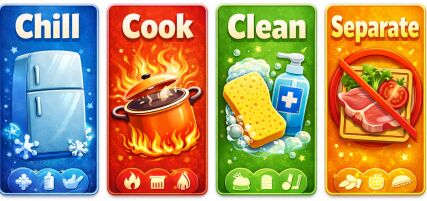 far from it and often very inaccurate. So, with all of the misinformation out there, it’s important for students to know what’s true versus what is false. With this Food Safety Myths & Facts activity, students learn the difference in a very engaging way. Read on to learn how this activity works.
Set
- Note: this activity can be used in a variety of ways. It can be a review activity after students have learned about the food safety actions in detail. If you need lessons for teaching that, you can take a look at a variety of lessons and activities that I have shared in the past which include: Food Safety Actions: Breakout Notes Activity, Food Safety: Web-Activity & Review and Food Safety & Sanitation. This activity can also be used as a review of the concepts for students in a food class that has studied the concepts in other classes such as an advanced culinary class that needs a refresh of the information.
- Introduce this lesson with a white board activity. Write the following food safety actions on the board or project onto a screen: clean, cook, chill and separate.
- Read the prompts individually and have students write down the area the action represents and whether the statement is a myth or fact. As you scan the room, choose some responses that may be correct as well as incorrect to see how they justify or explain their answers before giving them the actual answers. Prompts include:
- Cutting into meat to see if it’s pink is the best way to tell if it’s done. (cook)
- Hot food should never go into the refrigerator because it will spoil everything inside. (chill)
- It’s okay to rinse raw chicken before cooking it to remove bacteria. (separate)
- Washing your hands with water alone is just as effective as using soap. (clean)
- Share with students that they will be researching food safety claims just like these because many people get food safety information from family habits, social media, or what they believe to be common sense, but not all of it is safe.
Materials
- iPads or Laptops
- Projector or Screen
- White Boards
- Dry Erase Markers & Wipe Cloths
Activities
- Begin by having students complete the Food Safety Prediction form. Students read through the statements and predict if the statement is a myth or fact and then identify the food safety concept it represents.
- Place the cut up the food safety statements and randomly have students choose one from a basket or envelope. Explain to them that they will be researching the statement to determine if it is a myth or fact and explaining why. Go over the directions and show them the templates to be sure they know what they are doing.
- When students have finished their templates, place them around the room for a gallery walk activity. The students circulate the room, identify the correct answers then then complete the prompts which can be found at the bottom of the prediction form.
- Come together as a class to discuss how they did and see who got the most correct with both myths/facts and food safety actions. As always, if you need the key, just send me an email: kim@familyconsumersciences.com and I will gladly share.
- Optional: Use the templates to create a bulletin board or wall display about foods safety!
Attachments
- Food Safety Myth or Fact Prediction Sheet (PDF)
- Food Safety Statements to Cut Apart (PDF)
- Food Safety Myth or Fact Templates & Directions (PDF)
