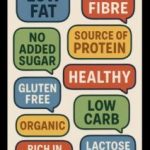
Claims made on foods can be very confusing to adults let alone students! In this Nutrition & Health Claims lesson, students learn the differences between the two in a variety of ways.

You may be familiar with the candy salad trend seen in Tik Tok and Instagram videos. While the educational value of blending various candies is debatable, there is a way to make the concept more educational. In this Candy Salad Family Project, students brainstorm a variety of candy types and then make connections to the personality descriptions of family members before creating their own family candy salad.

For years products have been decreasing in size, but not in price! This is known as Shrinkflation and in this lesson, students will learn what the concept means as well as how to calculate the percentage change in product sizes and then how consumers can fight back. This is a great lesson for a consumerism class, a financial literacy class or even a foods class!
It’s been my experience that many students, especially junior high, don’t know food safety concepts let alone practice them! The practices they believe to be safe are far from it and often very inaccurate. So, with all of the misinformation out there, it’s important for students to know what’s true versus what is false. With this Food Safety Myths & Facts activity, students learn the difference in a very engaging way. Read on to learn how this activity works.

Many students hate math and don’t see the relevance in the real world! If you can relate, you know that students will grumble, complain and resist doing math at every turn, especially when a fraction is involved. Math in the Kitchen was created based on a book I read where one of the main characters, who loved to cook, struggled with math. Her friend took a recipe and changed the wording to include math problems where basic multiplication, division and fractions were used to decode the actual ingredient amounts. I thought this was a clever way to have students practice math and see the real world connection in cooking and baking, so I created a few. Read on to check them out!

AI Companions is a new phenomenon that is rising at a growing rate. Is this phenomenon just a fad that will be here today and gone tomorrow? Or, is this an alarming trend that is here to stay? Either way, should we be concerned? In this AI Companions: Lesson & Activities, students explore the concept using the provided prompts before deciding if it is a good idea or a bad idea and completing follow-up activities.

Ultra-Processed Foods…talk about a topic that is in the news regularly…this is it! To help students learn more about Ultra-Processed Foods, I’ve created a variety of activities around the topic including chat stations, a drag and drop food sort, a dilemma for students to investigate and even a flashslide and warning label follow-up. Pick and choose or do them all!

Many schools are teaching a course around the priciples of education and cover the pioneers of education. Sometimes teaching about “famous” people can be dry and boring, so why not add an element of competition and gamification to jazz it up! The Great Race: Pioneers of Education places the learning in the hands of your students! The activity is from EduProtocol Field Guide (called The Great American Race). Students are responsible for preparing the clues for the race and then compete individually or in groups to see knows their pioneers the best and is the first to successfully complete the race!

Did you know that your brain needs fed with certain foods to function properly just like the rest of your body? Introduce students to these foods with this Brain Foods Mini-Lesson & Lab and the importance of daily consumption for school success! It’s an engaging way to get their brain and school year off to a great start!